History of Reedsburg and the Upper Baraboo Valley, by Merton Edwin Krug, Publ. February 1929 by the author. Printed by Democrat Printing Company, Madison, Wis., Page 266-269

(Written by Mr. O. D. Brandenburg, Madison, born in Ohio, but a boy of 8 on Narrows Prairie, and originally published in the Wisconsin State Journal, Sept. 25, 1921. Reprinted with his permission.)
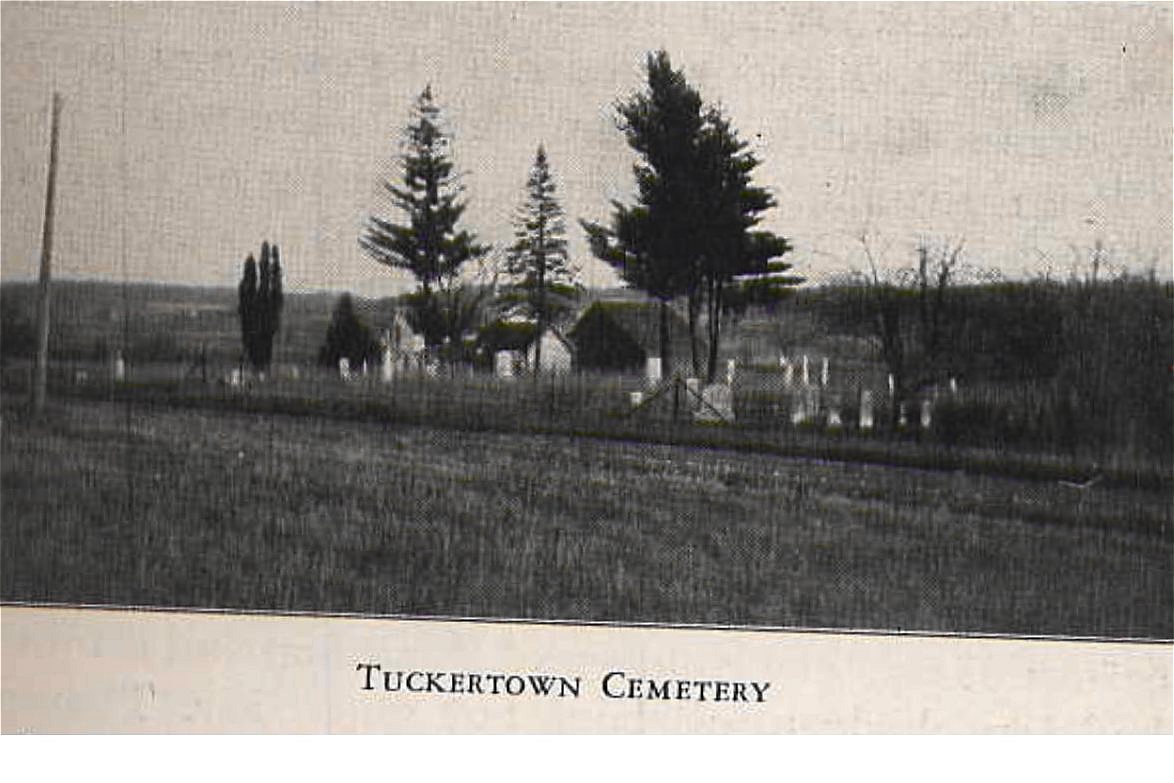
A little rural cemetery, commanding a wide and beautiful prospect far down the valley and clothed with much local historic interest, is that at decadent Tuckertown, a few miles west of Loganville in the township of Washington, hard by Hill Point, just beyond the Westfield boundary, Sauk County. This region was settled some seventy years ago, and here rest many of the local pioneers of that period. It was something of an Adventist community in the beginning, but now the church at the graveyard is Lutheran, like nearly all the countryside up and down Narrows Prairie.
Here sleep the PALMERS and DEARHOLTS, a scion of the family is a prominent Milwaukee doctor - COSTERISANS and CORSONS, HALES, HARRISES AND HARTS, KILBOURNS, LYNDONS, PURDYS, SEBRINGS, THOMPSONS and many more - all names associated intimately with the earliest colonization of the region, and borne today by many worthy descendants widely separated. Some birthdates graven upon stones and extending even back into the century which saw the birth of the nation.
Possibly the most notable grave is that of William PALMER, stout abolitionist, an assemblyman in 1865 and 1866, who came from Flushing, Ohio, in 1854 settling in Loganville, and, a contracting carpenter, built the first frame house in the village, later occupied by Frank DORN. He was interested with C. P. LOGAN, for whom the village was named, in erecting the first sawmill in the town, and with Joseph D. MACKEY in 1861 in founding the primal gristmill. In the mid '60s he owned the farm adjoining Kirkland at Devil's Lake, later known as the HOPKINS tract, now a part of the state park. He resided for about two years in Baraboo, then retired to his fine farm near Loganville, where he died in 1873 at the age of 68. He was born in 1805 at Havre de Grace, Maryland, and was married in 1833 at Philadelphia to Elizabeth MYERS. From 1828 to 1834 he lived in the Quaker city, moving then to Ohio. In 1850 he went to California for two years, and in 1854 migrated to Wisconsin. He had nine children, two sons serving through the Civil War, and one, Charles W., wounded in the shoulder by the same ball that killed Mr. RICHARDS, a Westfield neighbor. Mrs. PALMER died in 1893, aged 82. Mr. PALMER was an aggressive abolitionist before the Civil War and, like Thaddeus STEVENS, always an intimate and vociferous friend of the Negro. One of his daughters, Mrs. Florence PALMER BUNKER, last living child of the family, resides with a daughter, wife of a Reedsburg banker (Mrs. William HAHN). Beside Mr. and Mrs. PALMER in the Tuckertown cemetery rests a little son of twelve years who died in 1862. Mr. PALMER at one time owned 760 acres through which Narrows Creek wound its way to its confluence with the Baraboo at Ableman.
Back in 1865, the war not yet ended, Mr. PALMER was a force in having the legislature ratify the amendment to the federal constitution abolishing and prohibiting slavery,and on February 8 of that year, in the assembly, he made a fervid address in which, commenting upon the speech of O. F. JONES, of Dodge County, he, according to the State Journal of the time, "administered a severe castigation to the northern defenders of slavery". The most detestable creature on God's earth was, in his opinion, "the man who, born in the north and nurtured under the influence of free institutions, with no personal interest in the perpetuation of slavery, yet lends his talents to the advocacy of slavery, doing the devil's dirty work without pay for the mere love of it."
The vote in the assembly that followed was 72 for ratification and 16, all democrats, against, yet two democrats voted with the republicans there and six in the senate. In the assembly of 1885 Mr. PALMER was a chairman of the committee on local legislation and a member of the committee on roads and bridges, while in 1866 he was on the committee on town and county organization. Rollin M. STRONG was his associate from Sauk County in 1866.
Another well known pioneer, whose tomb is at Tuckertown, was Rev. Orin B. KILBOURN, born 108 years ago, now long at rest. He was a Litchfield, Connecticut man, going to Luzerne county, Pennsylvania at 17 years, marrying at Carrbondale in 1841, and coming to Wisconsin in 1858. He was twice married to half-sisters, and left six children. Rev. Henry PURDY, another clergyman, at rest here, born 1798, died in 1871, at the age of 73.
Samuel THOMSPON, now at 97 residing with his son Otto G. in Baraboo, has a wife buried in Tuckertown. He was born in Lycoming county, Pennsylvania, and was married to Harriet SEBRING, one of thirteen children of Jonathan and Sarah SEBRING. They had ten children, all boys but one. Mr. THOMSPON was town treasurer three years and a member of the town board one year.
Various of the COSTERISANS abide here. They were French, one being Janeann, who, wife of R. G. COSTERISAN, died at the early age of 16 years, in April 1866. Among the earliest of the COSTERISANS was Felix D., who, born at Lyons, France, in 1814, (fateful year for Bonaparte at Waterloo!) went to sea at 14, sailed in the merchant service five years, then three in the United States navy. Discharged in 1836, he was married in Tioga county in 1837, to Rachel M. SEBRING, also a daughter of Jonathan and Sarah like the wife of Samuel THOMPSON. He located in the Tuckertown region in 1859. Of this thirteen children, eleven reached adult years, and, combined, left a large progeny.
The Jonathan SEBRINGS also are in the silent colony at Tuckertown - Jonathan, progenitor of the Wisconsin branch, coming to Sauk county in 1855 and dying at the great age of 96 years and six months. He was a pioneer storekeeper, and his children were widely married over the community. One daughter became the wife of Daniel CORSEN; and CORSON burials are numerous at Tuckertown. A son, George L. SEBRING, followed his parents in the occupancy of the SEBRING homestead. He was born in Tioga county, Pennsylvania, and was married in Lycoming county in 1850 to Rebecca M. THOMAS, daughter of William and Anna McELAITH THOMAS. Mrs. SEBRING was a Clinton county girl, and after marrying lived for a time at Jersey Shore on a picturesque bend of the Susquehanna river. In the early 50's SEBRING was with the seekers after gold in California, but left Jersey Shore in 1867 for Wisconsin. Many of these Sauk county pioneers of the Narrows Prairie region, and its extension up to Tuckertown, followed old Jonathan SEBRING from the Lock Haven-Jersey Shore district of Pennsylvania and William PALMER from the Belmont county region of Ohio, among them being the RICHARDS, the STEWARTS, REIGHARDS, ATKINSONS and DORNECKS. Others migrated from Oswego and Clinton counties, New York, yet others from Vermont, many from Germany, and a few from England, occasionally one from Ireland.
Over beyond Loganville, well down on Narrows Prairie, in pioneer times, resided one N. H. BRIGGS, an able, argumentative pseudo-farmer, sandy of complexion, prodigiously bewhiskered, whose gentle little wife kept a scrupulously clean log home and here lived William BRIGGS, one of the several sons, whose own son, Clare, in due time was destined to become one of the most famous of American cartoonists.
As usual in an old rural cemetery, sadly enough, this Tuckertown graveyard has somewhat gone to decay. Grass is ill-kept, stones often aslant, some prone, others soon will be, yet the place is rich in history, and what of romance, perhaps of tragedy, might not its silent records reveal!
Submitted by Carol