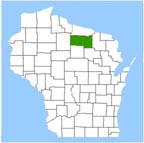
 ONEIDA COUNTY

|
|
Logging Railroad History
Oneida County History
1.)Mohr Lumber
Company. The history of the logging lines that connected to the Milwaukee Road
Wisconsin Valley main at Rantz Spur or Hixon is very complex. Rantz Spur was
located about a mile north of Hazelhurst. The first operator was O'Day & Daley.
In 1900 he constructed a line that ran southwesterly from Rantz to Lake
Seventeen. In 1900 the Milwaukee operated the line as a logging spur, but O'Day
took over its own operations the following year. In 1903 O'Day sold out to
Gilkey & Anson who extended the line further southwest to the Tomahawk River.
O'Day also owned a smaller line around this time connecting with the Milwaukee
at Harshaw and operating around O'Day Lake. This line ran about 1899 and was
operated by the Milwaukee as a spur. Logs from both of the O'Day operations went
to the Merrill Lbr Co. mill in Merrill. In 1909 Gilkey & Anson ended operations
and tore up most of the line except the one and a half miles closest to Rantz.
That portion of the line was sold to the A. H. Stange Lumber Company of Merrill.
Stange extended the line almost due west to their Camp Nine located in section 3
town 38 north range 5 east. Stange ended logging operations here in the 1911-12
season. In 1912 a hearing was held before the Wisconsin Railroad Commission to
determine if the line was common carrier trackage or only a private logging
spur. (The Milwaukee owned the rail and wanted to tear it up. Local residents
didn't agree with the idea.) The Railroad Commission took the position that the
line was a private logging railroad. The track was not removed, and in 1913 the
Mohr Lumber Company built a line that extended west from Camp Nine into western
Price County. Together Kneeland-McLurg Lumber of Phillips, and the Mohr Lumber
Co. had a line running from the Wisconsin Central main at Phillips to the
Milwaukee Wisconsin Valley Line at Rantz Spur. There was never any through
service, however. Mohr Lumber Company discontinued operations in 1923 following
the death of the owner. Mohr's mill was located at Tomahawk, but rail operations
were based out of Hazelhurst. The former Stange line from Rantz Spur to Camp
Nine remained in operation by the Milwaukee until 1931.
2.)
Kneeland-McLurg Lumber Company. Trackage in the far west central portion of the
county. (see Price County Page for info.)
3.) Bissell Lumber Company. In
1918 Bissell Lumber Company bought a mill in Tripoli. In 1919 construction was
begun on a railroad that ran north from Tripoli into the Pier Lake area, with
spurs that reached into eastern Price County. There was also trackage south of
Tripoli in Lincoln County. Operations on Bissell's road ended in 1928.
4.) Garth Lumber Company. From 1889 until 1895 the Garth Lumber Company built a
sawmill on the north shore of Garth Lake. It seems that the Milwaukee Road built
a spur to connect the mill with its main line. The Milwaukee probably carried
out all operations.
5.) Hazelhurst & Southeastern Railroad. In 1888
construction was begun on a line extending southeast from Hazelhurst by the
Yawkey & Lee Lumber Company. This line was not a common carrier. It was referred
to as the Lake Catherine and Southeastern. In 1892 Yawkey & Lee became the
Yawkey Bissell Lumber Company. Yawkey Bissell then incorporated the Hazelhurst &
Southeastern as a common carrier railroad on Jan 30, 1896. The railroad was
extended southeast to a connection with the C&NW; Ashland Main at Mc Naughton.
(Originally called Hazelhurst Jct.) This gave Yawkey-Bissell a connection with
the C&NW; for its lumber, as well as a logging railroad. It also gave the Land
Log & Lumber Company mill at Mc Naughton a connection with the Milwaukee. The
H&SE; built a long branch south from the main that ended near Soo Lake. H&SE;
had trackage rights on the Milwaukee main north from Hazelhurst to Arbor Vitae.
It tied in with the Trout Lake Railroad, the Arbor Vitae Logging Railroad, and
several other lines owned by Yawkey-Bissell in Vilas County. None of those lines
were ever officially part of the H&SE; however. In 1901 the H&SE; decided to
shorten its line and built a new connection to the C&NW; at Lake Tomahawk. This
allowed them to abandon the much lengthier line to Mc Naughton. The
Yawkey-Bissell mill in Hazelhurst closed in October of 1911 pretty much ending
the H&SE;'s usefulness. The H&SE; provided mixed train service on its main line
throughout its life. The Hazelhurst & Southeastern was dissolved on May 11,
1914.
6.) Land Log & Lumber Company. In the 1890's Land Log & Lumber
operated two sawmills in Oneida County. One sawmill was located at Mc Naughton
and the other at Lake Tomahawk. At this time several spurs were constructed off
of the C&NW; main at Mc Naughton and northwest of Lake Tomahawk to serve logging
operations of this company. The spur at Mc Naughton was originally built in 1891
It seems that around 1895 rail operations were shifted to the Lake Tomahawk
mill. Rail operations seem to have ended about 1898.
7.)
Alexander-Stewart Lumber Company. In 1885 the Milwaukee Road constructed a
branch northeasterly from a station called Deer Trail which was located about 3
miles north of Heafford Junction. The line was initially constructed to serve
timber lands owned by Alexander-Stewart and also by the Goodyear Lumber Company
and Gilkey & Anson. The line extended from Deer Trail to a point about a mile
and a half south of Mc Naughton. The northeastern most portion of the line
served Alexander-Stewart's lands. It is probable that the Milwaukee provided
equipment and operated the line on behalf of A-S. Alexander-Stewart's mill was
located in Wausau. Rail operations here seem to have ended about 1895. The
Alexander-Stewart Lumber Co remained in operation until 1912
8.) Goodyear
Lumber Company. In Jan. 1896 the Goodyear Lumber Company moved its logging
operations north from Jackson County to the area around Josie Lake and Goodyear
Lake in western Oneida County. As described above the Milwaukee Road built a
branch to serve this area. Several spurs were built to Goodyear Lumber Company's
operations. The chief camp was located at Josie Lake. Goodyear incorporated the
Rhinelander & St. Paul Railroad to operate the Milwaukee branch to Josie Lake
and to construct a line east to Rhinelander. The Rhinelander line was never
built and it was never more than a local logging railroad. In 1899 Goodyear
discontinued logging operations in this area and moved further north into Vilas
County. Following Goodyear's and Alexander-Stewart's departures, the Milwaukee
maintained about a 5 or 6 mile portion of its line running northeast from Deer
Trail to serve other lumber and pulpwood interests. This line remained in
service until the mid 1920's.
9.) Langley & Alderson. In the spring of
1901 Langley & Alderson, a large logging contractor, built a small logging
railroad that ran south from a point on the SOO about 3 miles east of Heafford
Junction to Manson Lake in order to haul out logs stored in the lake. Later that
year a line was north about three miles from the SOO main. This line remained in
operation until 1902. Logs from both these lines went to the Merrill Lbr. Co.
mill Also in 1901 a seven mile line was built northwesterly from Bradley Jct
along the Rice River. This line was utilized to haul logs to the Bradley Co. in
Tomahawk. Langley & Alderson also had extensive operations in Vilas Co. (see
that page)
10.) Geo. E. Wood Lumber Company. This line operated in a
northwesterly direction out of Woodboro from 1896 until 1904 when Wood's mill
burned down.
11.) Thunder Lake Lumber Company. Narrow Gauge, this is
probably one of Wisconsin's best known logging railroads. Operations were begun
out of Rhinelander in the spring of 1893 by the Brown Robbins Lumber Company.
The line was constructed because low water in Pine Lake Creek prevented the
annual log drives that spring. The line ran northeasterly from Rhinelander and
ended at Pine Lake. In 1894 the line was extended to what is now the present
village of Sugar Camp. At the time the village was known as Robbins. Several
logging spurs were built in the Robbins area, and mixed train service was
offered between Robbins and Rhinelander. A small sawmill was located there to
meet local needs and to supply company needs as well. On April 15, 1898 the
Brown-Robbins Railroad was incorporated as a common carrier. In 1901 the company
became simply the Robbins Lumber Company. The railroad was then incorporated as
the common carrier Robbins Railroad. From the beginning of operations up until
1917 the railroad carried large amounts of logs for the Brown Bros Lbr Co also
located in Rhinelander. In 1919 Robbins was bought out by the Thunder Lake
Lumber Company. Thunder Lake abandoned the main line from Pine Lake to Robbins,
and extended the railroad in a northeasterly direction towards Three Lakes. In
the early 20's logging operations were centered about Julia Lake on the
Oneida-Forest County line. Over the years the line was extended northerly and
easterly until it reached Kentucky and Spectacle Lakes in southeastern Vilas
County. In 1938 the main line was some 48 miles in length. Final logging took
place in the Butternut-Franklin Lakes area ending in the spring of 1941.
Throughout this time the Robbins Railroad was a common carrier. It was the last
narrow gauge railroad in Wisconsin, and the last narrow gauge common carrier
railroad in the Midwest.
12.) Lincoln & Oneida Railroad. This line
extended northeasterly from Jeffries on the Lincoln-Oneida County line. The
C&NW; had built a spur to Jeffries in 1891. In the fall of 1901 the Jeffries
Lumber Company began construction on what it called the Jeffries Log Railroad,
also called the Jeffries & Northeastern. On Aug 31, 1904 the Jeffries Log
Railroad was incorporated as the common Carrie Lincoln & Oneida Railroad. In
1908 Jeffries Lumber was bought out by the Bundy Lumber Company. The railroad
remained in operation until 1912 when it was abandoned.
13. Wolf &
Wisconsin Railroad. This line was built by the George W. Pratt Lumber Company
west from Post Lake to logging lands near Pelican Lake. The logs were to be
dumped into Post Lake and floated down the Wolf River to the mill at Oshkosh.
Construction on the line began in 1885. (The W&W; RR was incorporated on Oct. 7
of that year) In 1888 the line reached as far west as Harrison, and a branch to
Parrish was built the following year. The Milwaukee Lake Shore & Western bought
the line in 1889 and utilized the portion west of the village of Pelican Lake
(Pratt Junction) as part of a branch line. The portion east of Pelican Lake was
abandoned shortly after purchase. In 1893 the MLS&W; became the Ashland division
of the C&NW.; That portion of the line which was a part of the C&NW; branch
remained in service until 1951.
|