
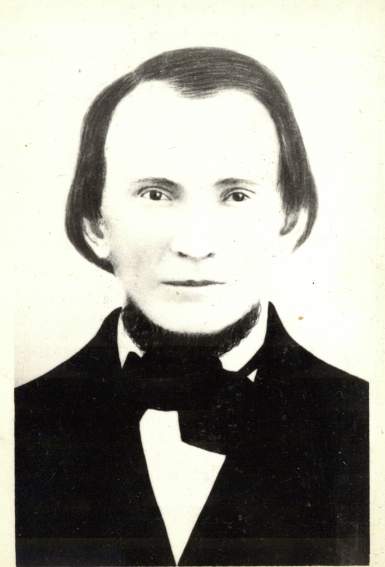
Eliab Foster
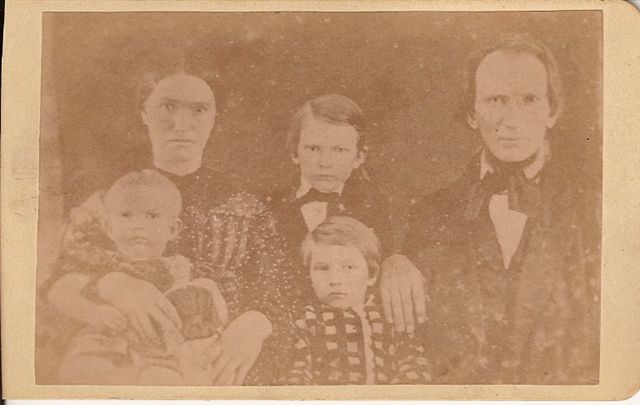 Martha Clark Foster
holding infant daughter Angeline: Robert and Arista with father Eliab taken
about 1856 in Kenosha Wisconsin Thanks to Susan Nelson for the photo.
Martha Clark Foster
holding infant daughter Angeline: Robert and Arista with father Eliab taken
about 1856 in Kenosha Wisconsin Thanks to Susan Nelson for the photo.
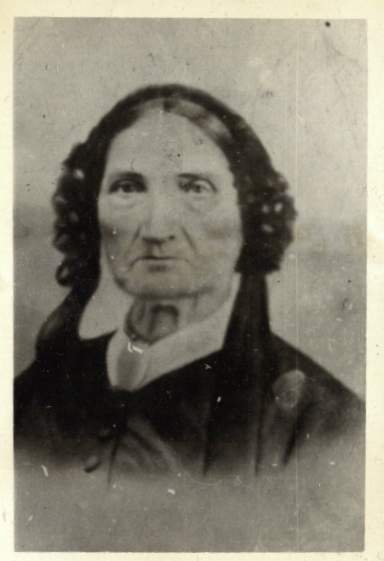 Olvie Bettis Foster Terpening
The Fosters were pioneers. It is through this line that I can trace the family
to some of the earliest European settlers of New England, including Stephen
Hopkins, who sailed on the Mayflower.
Eliab Foster was twice a pioneer, moving from his native New York first to
Kenosha County, Wisconsin, and then to Ford County, Illinois. His family was
recognized as one of the first to settle Lyman Township, and his son, Bela,
wrote articles about the history of the township in The Roberts Herald.
Eliab Foster married twice, to sisters. After the death of his first wife, Jane
Rebecca Clark, he sent for her sister, Martha, to come to Wisconsin to look
after his sons Robert and Arista. Soon after, they were married. Since Jane and
Martha had been orphaned at an early age and "farmed out" to relatives and
friends, I am sure they looked upon moving to Wisconsin as an adventure.
One interesting side note: Eliab and his wives were cousins, having common
ancestors in Capt. William French and Samuel Stratton.
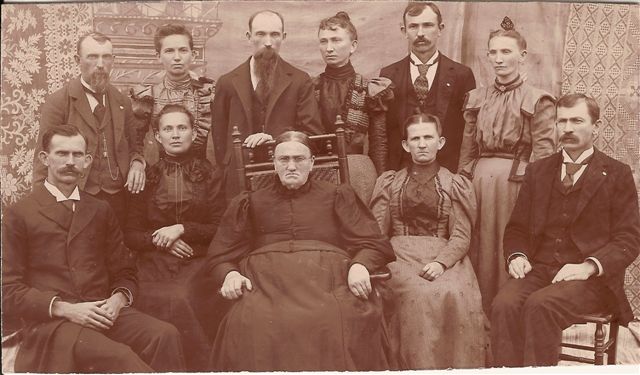
Martha Clark Foster (center) with her children 1903: Bela is seated left, next to him is Angeline, next seated is Martha, then Olive (?), and Sela (?)
Standing left to right is: Robert (?), Martha, Arista, Leda, Parley, Francis. Thanks to Susan Nelson for the photo.
 Parley John
Foster 16 yrs old
Parley John
Foster 16 yrs old
 Parley and Sela
Foster 1903
Parley and Sela
Foster 1903
Leda and Martha Foster
By Frank H. Lymna, published 1916
From an article on Volney L. Bassett, pp 540, 543, 544
Note: Genealogical information on the Foster family extracted from this piece.
Mr. Bassett was married on the 25th of December, 1855, to Miss Adeline Foster,
who was a daughter of Andrew W. Foster and Prudence (Cornwall) Foster and was
born in Oswego County, New York, on the 26th day of September, 1831. The Foster
family is one of the oldest in Massachusetts …{what follows is a list of
illustrious Fosters, none of whom I have been able to directly connect to our
Foster family} William Foster, the grandfather of Mrs. Bassett, was born on the
22nd of November, 1783, and followed agricultural pursuits in Oswego County, New
York. He fought in the War of 1812 and while at the front participated in the
Battle of Sackett’s Harbor. He married Olive Bettis, who was born July 10, 1785,
and who passed away on the 19th of February, 1877. They had a family of thirteen
children, all of whom are deceased save Julia, who was born on the 12th of
February, 1830, and is the widow of Joseph Hicks, her home being at Genoa
Junction.
Mr. & Mrs. Andrew W. Foster were both born in New York and resided in Oswego
County for many years. He was a carpenter by trade but on removing to Kenosha
County, Wisconsin with his family in 1841, purchased a farm of sixty acres in
that township about three miles northeast of Salem Station. His wife, who was
born in 1808, passed away in 1895, when in her eighty-seventh year. In early
life they belonged to the Methodist Episcopal Church but later became identified
with the Spiritualists. They were the parents of six children: Mrs. Adeline
Bassett; Betsey A, the wife of Fred Plank of Petaluma, California; Andrew W, who
died in Genoa Junction in 1900; Leander E, who died when nineteen years old;
Orlando J, a resident of Fond du Lac, Wisconsin; and Julian A, of Salem Station.
Mrs. Bassett was one of the first teachers of Kenosha County, opening her first
school in her father’s bedroom with a few children in attendance.
The Roberts Herald
January 1939
Bela Foster
Bela Foster, son of Eliab and Martha J. (Clark) Foster, was born at Salem,
Wisconsin, July 6, 1861, and died at his home in Roberts, Illinois, at 3:00 p.m.
Wednesday, January 4th, 1939, aged 77 years, 5 months and 28 days. His death
came as a surprise and shock to the community as he was not known to be
seriously ill. He had been slightly ailing with coronary thrombosis but this was
not considered to be serious so that his death came very unexpectedly.
Mr. Foster came with his parents to Illinois when he was four years old. They
settled on the prairie in section two northeast of where Roberts was later
located. At that time Lyman Township had not yet been organized. The railway
through here had not been built. Roberts and Thawville only to come in the
future history. Settlers were few. He lived through the trying times of the
pioneers. He remained on the farm for 25 years. In the mean time he attended the
public schools of his district and took a teacher’s course in one of the early
normal schools. He then taught school until 1903. For a time he was principal of
the Roberts school.
…All [his] former pupils held him in high esteem. In his school work as in the
actions of his whole life he always was just and kind. If erred in justice it
was because of kindness. He was one of the most conscientious men in the whole
community. For him the greatest pleasure in life was in helping the needy or
doing some kind act for someone else whether more needy than himself or not.
In 1903 Mr. Foster was appointed to the position of rural mail carrier of Route
No. 2 out of Roberts. This position he held for 23 years making his last trip on
the 30th day of July, 1926.
On the 14th day of September, 1904, he married Miss Christina A. MacKay of
Chicago, who survives him. He is also survived by one brother, P.J. Foster of
Roberts, three sisters, Miss Leda Foster of Roberts, Mrs. Angeline Haling of
Thawville and Mrs. Frances Ruedger of Carson City Michigan, several nephews and
nieces and many other relatives and a host of friends who join the family in
sorrow.
In his early life Mr. Foster untied with the Congregational Church in Thawville.
In 1891 when the family moved to Roberts he transferred his membership to the
church here and during the almost half a century since that time he has been
ever active in the work of the church. He was loyal in attendance and he was
always willing to do his whole part in furthering the success of every Christian
undertaking. He held the position of Sunday School Superintendent for some time
and was a deacon in the church for many years. Besides his work in church and
school he held several important public offices. He was village clerk for a
number of years and also served as clerk of Lyman Township. He never tried to
make himself conspicuous but ever tried to bring happiness to others while
keeping himself in the background. He was a lover of flowers and raised
beautiful ones in his flower garden, enjoyed taking or sending them to the sick.
The funeral services were held at the Congregational Church in Roberts Friday,
January 6th, at 2:00 pm
Relatives and friends from a distance who attended the funeral included Mrs.
Helen Haight, Toronto, Canada; Miss Rosalind MacKay, Pittsburg, Pennsylvania;
E.S. MacKay and son Ted and daughter Mrs. Erica Swanson and Mr. And Mrs. F. B.
Gebhardt of Chicago; Mr. And Mrs. R.L. Ruedger of Carson City, Michigan; Mr. And
Mrs. Clark Ruedger, Frederick Blome; Mrs. Lloyd Borden, Sheboygan, Wisconsin;
Dr. and Mrs. F.M. Blome and daughter Louise , Kenney; Mr. And Mrs. Merna Pruit,
Mrs. Sarah Roberts, Mrs. Minnie Funk, and Robert Hawthorne of Champaign; Mrs.
Hilda VandeWater and Leon of Eureka; Mrs. Perry LaBounty of Bloomington; Mr. And
Mrs. Dewayne Lake of Chebanse; Dr. and Mrs. R.E. Squires; Mrs. John Boyle, Miss
Anna B. Wilson, Mrs. Elizabeth Jennings, Mrs. Clair Bishop, Mr. And Mrs. Brown
of Piper City; Mr. And Mrs. George Haling and daughters Mrs. Elmer Dindgledine
and Mrs. Edna Stanley and Mrs. Iva Cramer of Peoria. Mr. And Mrs. Robert Adamson
and Mr. And Mrs. Peter Anderson of Paxton; Mr. And Mrs. Willard Kenward and
Forrest Thompson of Melvin; Mrs. Angeline Haling, Mr. And Mrs. Russell Frazee,
Mr. And Mrs. George Wallis, Harry Kenward, Mrs and Mrs. William havens, Mr. And
Mrs. John Woodward and James Goodrich of Thawville; Mr. And Mrs. L. C.
Ringeisen, Gibson City; Mr. Lindelhof of Sibley; Mrs. And Mrs. George Lee of
Strawn; Mrs. George Smith and Mrs. Al Smith of Onarga.
Martha Foster, daughter of Eliab and Martha J. (Clark) Foster, was born in Salem
Wisconsin November 11, 1862, and departed this life at her home in Roberts,
Illinois Wednesday, January 10, 1934, aged 71 years, 1 month, and 29 days. When
she was three years of age, in the fall of 1865, her parents and family moved to
Illinois, settling on a farm four miles northeast of the present location of
Roberts. The country was wild and unbroken, with a few settlers here and there.
The railway had not been built through these parts and Ford County had only
recently been organized. Lyman Township was as yet unknown and the locating of
Roberts and Thawville some years in the future. The locality was part of Brenton
Township and was known as south Brenton.
Martha was one of the youngest of the family of ten girls and six boys. Five
girls and one boy died in infancy leaving five girls and five boys to grow to
manhood and womanhood. The father died in 1872 leaving the mother ten children
to care for. They remained upon the farm for eighteen years after the fathers
death and then moved to Roberts.
Her mother preceded her in death several years and three brothers and one sister
of those who lived to adult age have gone before. These are Robert C. Foster,
Arista Foster, Sela Foster, and Mrs. Olive Kenward. She leaves surviving two
brothers and three sisters. Parley J. Foster, Bela Foster, and Miss Leda Foster
of Roberts, Mrs. Angeline Haling of Thawville, and Mrs. Frances Ruedger of
Carson City, Michigan. She also leaves behind numerous nieces and nephews and
numerous relatives and friends who join the family in sorrow.
As a young lady she consecrated herself to the Christian life and was baptized
and united with the Congregational Church in Thawville and has been a loyal and
active worker in its various organizations since that time. When she came to
Roberts, her membership was transferred to this place. Those who best knew Miss
Foster knew that the mere [illegible] of being a Christian never satisfied her.
Her Christianity was such that it reached into her everyday life. Her whole life
was devoted to increasing the comfort and happiness of others. Members of her
family, her relatives, her friends, and her neighbors. And to her, anyone in
need was a neighbor. Her profession, that of a nurse, gave her the opportunity
to administer to the suffering which she was ever ready to do. But regardless of
whether she was called professionally or merely came as in neighborly kindness
her services were ever ready and her name held in reverence by several people.
Funeral services were held at the Congregational Church Friday.
Sela Foster, son of Eliab and Martha J. (Clark) Foster was born in Salem,
Kenosha County, Wisconsin September 19, 1857, and departed this life in his home
in Roberts, Illinois Tuesday morning, January 17, 1933, aged 75 years, 3 months,
and 5 days.
The first eight years of his life were spent at the place of his birth. In
September, 1865, the family moved to Iroquois County, Illinois, and lived for a
few months on a farm just east of Thawville. In the spring of 1866 they came to
what is now Lyman Township to a farm northeast of where Roberts is now located.
When Mr. Foster grew to manhood he worked on a farm for a few years and then
moved to Roberts and worked for Lisk & Lyman, and later for Lisk & Harding, then
Lisk Brothers. These firms were successors in the same business firm. They
conducted a hardware store and also a creamery and butter making establishment.
Mr. Foster was employed at various times in both establishments. He also worked
for W.C. Wright in the hardware business. He then opened a hardware store of his
own. He has conducted this business since[sic] since, except for a short time
when he lived at Friendship, Wisconsin. At the time of his death he had been in
business longer than any other business in town.
The 27th of October, 1887, he married Miss Sarah Harriet Whorrall, who survives
him. To them were born five daughters. One, Grace, died in childhood. The
surviving ones are Mrs. Pearl Jean Montague of Lyalta, Alberta, Canada; Mrs.
Blanche Lorene White of Roberts; Mrs. Ora Deborah Squires of Piper City; Mrs.
Mae Aldene Gebhardt of Chicago. He also leaves three grandchildren, Ralph and
Ethel Montague and Ruth Squires; two brothers, Parley J. and Bela of Roberts;
four sisters, Misses Leda and Martha Foster of Roberts, and Mrs. Angeline Haling
of Thawville, and Mrs. Frances Ruedger of Carson City, Michigan.
Mr. Foster was a man who never forgot a friend. He never failed to appreciate a
favor. He had a high standard of honor and believed in conducting his life in
accordance to that standard. He was one of the most accommodating of men and
would go far out of his way to perform some service for another. He was
outspoken in his beliefs and never pretended to be what he was not. He was
always generous to a friend or to a stranger. To describe his life in a few
words we would say “He was a good citizen.” In church affiliation he was a
lifelong member of the M.E. Church.
By Louise Seth, their niece
It was in Roberts, Illinois, where many of our Foster relatives lived. We
visited them several times a year and when I was old enough my brother and I
would go there for a week or two in the summer. Mom and Dad would put us on the
train in Kenney and relatives met us at the depot in Roberts.
When I was very young I would be very excited at the prospect of a visit to
Roberts. We made the trip by car and as soon as we arrived at Aunt Leda’s house
which was next to Uncle Bela’s house. Dad and I would go to find the uncles.
They were usually working in the garden behind the houses. I can remember
scampering down the path which seemed to stretch forever and there would be
Uncle Bela stooped down holding out his arms for me. I always got a big hug and
a tickly kiss from Uncle Bela who had a bushy mustache. Then he would swing me
up on his shoulders for a ride back to the house. How happy I felt—so high up I
could touch the sky. I always felt bathed in love here and particularly around
Uncle Bela.
Uncle Bela was the only one of Mom’s uncles that cuddled and hugged the wee
little ones. He and Aunt Teen (Christina) had no children. They had both been
school teachers and were in their 40s when they married.
Uncle Rit (Arista), the older half brother, was also a very kind, gentle man
like Uncle Bela. He wore a General Grant beard. He was born before 1852 so was
quite old and seemed frail and needed to rest a lot. He was generous with his
few pennies and shared them with young nieces and nephews. When he was able,
Uncle Rit mowed lawns to earn money.
Aunt Leda and Aunt Matt (Martha) lived in the family home. Aunt Matt was a
practical nurse and worked at the small town hospital whenever there were
patients. Aunt Leda kept house, sewed for others and quilted. The Aunts were
expert quilters and could all make tiny fine stitches. Neither Aunt Leda nor
Aunt Matt was married. Mom’s cousin, Oma Foster Squires, told me that their
mother would not let them marry as she expected them to take care of her—which,
of course, they did. Perhaps they received title to the house in exchange for
this care. It was a two-story house with an addition on the back, which was at a
lower level than the front. A ramp connected the kitchen part. This kitchen had
no running water or even a pump. There was a small wood/coal burning range for
cooking, some shelves for pots and pans and a table at which to work. Behind the
kitchen was a room that held large rug looms. I only saw the interior of the
room form the doorway. Children were not allowed in. I don’t know whether or not
they wove rugs for sale, but assume they did.
Two brothers also lived in the home place—Uncle Parl and Uncle Rit. Uncle Parl
was divorced and not home too often as he worked as a guard at Joliet State
Prison. When he retired from that job he was night watchman at a store in
downtown Roberts. He suffered and died from asthma.
Uncle Sela owned a hardware store in Roberts. He had a hand-operated elevator
which I used to like to ride if someone would pull the ropes to take it up to
the second floor and back down. He had four daughters. One married and lived in
Canada. She had two children, Ralph and Ethel Montague. Oma married a dentist
and lived in nearby Piper City. Her daughter, Ruth Rae, was murdered in the
Chicago area when she was in her twenties, leaving a daughter who was found
sitting unhurt by her mother’s body. The two other daughters, Mae and Blanch,
lived in Chicago. Blanch worked in a bank in the Chicago area and left there and
came back to Roberts, where she and her husband ran the hardware store. Blanch
left Chicago to avoid having to testify against the notorious gangster, Al
Capone.
Mother had another aunt who lived in Thawville, which was near Roberts. Aunt
Line (Angeline) Haling was a jolly chubby lady who had several children of her
own, but also raised the baby son (Harry Kenward) of her sister Olive who died
in 1903. Dad courted Aunt Line’s daughter, Nettie, before he met Mother. Another
of Aunt Line’s daughters, Irene Haling Frazee, was a Holiness missionary in
Guatemala for some years. She always managed to say something in Spanish
whenever we saw her, even though we didn’t understand the language. Irene was
considered an old maid, but surprised us all by marrying after she was 50.
I knew Aunt Leda best as she often came to Kenney to look after us when Mom was
hospitalized, which was quite often. It was here at her house I stayed when we
visited in the summer. Cousin Della stayed in town with me, and Frederick stayed
in the country with her brother, Lawrence Seng.
Della and I always slept in Uncle Parl’s room. It was a small room with a
sloping ceiling and only one window, and was very warm on hot summer nights.
During one of our summer visits, Aunt Teen invited just Della and me to dinner.
Before we left, Aunt Leda told me, “You must eat whatever Aunt Teen serves.”
When we arrived, Aunt Teen had the table set with gleaming white linen, sterling
silver, and her set of Haviland China that was decorated with delicate blue
forget-me-nots. We were greatly impressed that she had gone to so much bother
for two little girls. The meal progressed well. I enjoyed everything offered
me—until dessert! TAPIOCA PUDDING! I had never been able to stomach puddings,
and of all the different kinds, tapioca was the worst. I was completely
dismayed. I knew I had to eat the horrid stuff—but how was I going to get it
down and keep it in my stomach? Then I noticed a dish of strawberry jam. So on
each bite of pudding I put a dollop of jam and thus was successful in eating my
allotted serving.
After road conditions improved and cars became more reliable, we used to drive
to Michigan more than once a year. Whenever she could, Aunt Lead went with us.
The last time I remember riding with her was when Steve was a baby and we were
probably taking her up to spend a vacation with her sister Frances, my
grandmother. Aunt Leda played with Steve and would shake her head close to him
so he could grab her hair.
Another time when we were driving through Michigan, we came to a stump fence.
Aunt Leda said, “I have been told I am as ugly as a stump fence. I now know how
ugly I am.” This was upsetting to me as I always considered all my great aunts
as beautiful people and could not understand why anyone could have called my
beloved Aunt Leda ugly!
Many Fosters and some Ruedgers are buried in Lyman Township Cemetery in Roberts.
I believe all the graves are marked except for Aunt Matt’s and Uncle Rit’s.
Andrew W. Foster—b. Oct. 24, 1806 d. Jan. 4, 1892
Prudence Foster, wife of Andrew—b. June 23, 1808 d. Dec 6, 1896
Leander E., Son of AW—d. Dec. 7, 1861 aged 19yrs, 4 mos, 7days
Julian A. Foster—Sept 3, 1853-June 19, 1935
Huldah E, wife of Julian A. Foster—April 17, 1860-May 2, 1917
Julian A. Foster, Jr. 1879-1947
Jane R, wife of Eliab Foster—d. Jan 16, 1852, aged 26 yrs, 2 mos, 22 days
Nancy J, Daughter of E & JR Foster—d. Oct 3, 1850 aged 1 yr, 2 mos, 20days
Martha J, Daughter of Eliab Foster—d.Feb. 19, 1856 aged 2 yrs. 4 mos 22days
Emma, wife of Andrew W. Foster—March 26, 1845-March 8, 1923
Peter Van Alstine-Nov 28, 1800-Nov 2, 1891
Eliza Van Alstine-Mar 9, 1813-July 29, 1832
Our Mother,Olive, Wife of John Terpening d. Feb 19, 1877 aged 91 yrs. 7 mos 9
days
Eliab Foster—1808-1872
Martha Foster—1828-1908
Dora Bell Foster, Dau of E & M Aug 9, 1871 (this tombstone, easily the oldest,
was south of the parents’ graves, broken and lying on the ground, covered with a
footstone DBF. Some space between the parents and Dora Bell suggests other
children may be buried there.
Bela Foster—1861-1939 (stone read 1931)
Christina Foster—1863-1945
Leda Foster—1860-1950
Edward S. Haling 1850-1928
Angeline B. Foster Haling 1854-1941
Samuel S. Kenward, father, 1861-1933
Olive E. Kenward, mother, 1864-1903
Sela Foster—1857-1933
Sarah H. Foster—1865-1949
Grace, daughter of Sela and Hattie Foster, died Mar 21, 1901 aged 14 days
Fred Bruce Gebhardt 1893-1945
Mae Foster Gebhardt died 1971
Charles W. Wright—1891-1969
Blanche Foster Wright—1891-1978
From History of Andover, MA by Sarah Loring Bailey,
Boston, 1880
(online at genweb.net/~books/)
In the trials, eight citizens of Andover were condemned. Three of these were
hanged: Martha Carrier, Samuel Wardwell, and Mary Parker; one died in prison,
Ann Foster; Abigail Faulkner was reprieved and by the delay ultimately saved;
Sarah Wardwell and Elizabeth Johnson and Mary Lacey were condemned at the very
latest trial January 1692 and set free on the general jail delivery, when the4
frenzy was checked.
In the examinations of the accused which preceded the regular trial, most made
confession and thus averted the extreme penalty.
p. 207
Several women of Andover who confessed accused Martha Carrier as the cause of
their being led into witchcraft. Three of these were Ann Foster, her daughter
Mary Lacey, and her granddaughter Mary Lacey, Jr. Ann Foster said she rode on a
stick with Martha Carrier to Salem village, that the stick broke and she saved
herself by cling around Martha Carrier's nec k. She said they met 300 witches at
Salem village, among them the Rev. Mr., Burroughs and another minister with gray
hair (Mr. Dane, of Andover, was supposed to be hinted at). This story was
confirmed by the daughter and granddaughter. Besides these ridiculous charges
there were others which had more foundation in truth. All the events of Martha
Carrier's past life were gone over, and her rash speeches and revengeful words
brought up, with some facts which looked greatly against her
p. 213-216
Another who was condemned was Ann Foster. She, however, was not hanged, having
died in prison before the law could take its course. She was an aged woman, a
widow, without friends of influence to give aid in her distress. She was
evidentally weak in mind and body and was ready at the trial to confess almost
anything, and believe everything which was suggested against herself. Indeed,
some of these women had been so long used to contemplate their natural and
acquired depravity in its most aggravated form, that some of the sensation and
self-accusing were ready, even in their ordinary religious meditation, to regard
themselves as guilty of almost all sin, believing literally that "he that
offendeth in one point is guilty of all". The piety of Ann Foster is especially
spoken of by her sons, and there can be little doubt that she was led to charges
herself with the sin of witchcraft in all sincerity and contrition. A
broken-down old woman in her decrepitude and weakness, torn from her quiet home,
brought on a long journey to a prison and a court room, accused of blasphemy her
God and forsaking her Savior--what wonder if she sand and died under such a
weight of miseries. She was four times examined--July 15,16,18,21. It is pitiful
to think of this poor, toddering, feeble creature, dragged again and again
before her accusers and finally dismissed to the sheriff to be "taken care of"
as guilty.
She overdid in confession, or she would, like the others have doubtless been
saved. But the law must have victims, and here was one who proved herself to be
deeply guilty. She confessed that she bewitched a hog of John Lovejoy's, caused
the death of one of Andrew Allen's children, made another child sick, and "hurt"
Timothy Swan. She said her manner of hurting was to make images of the persons
with rags ("poppets" they are called in the records) and stick pins in them, or
"tye knots in the rags" or burn them in the fire. The persons whom these images
were supposed to represent would suffer whenever she pinched or burned, or
picked the "poppet".
The deluded woman also described extraordinary apparitions which she had
seen--birds, with great eyes, which first were white and became black when they
flew away, by which she knew they were devils, also black men who were devils.
She had been at the witch meetings and seen the Rev. George Burroughs and
another minister with gray hair. Again and again she repeated and owned this
confession. But on one point she was obstinate. She would accuse herself to any
extent, but she would not accuse her daughter. For this her examiners lost
patience with her. "You have already three times examined," they exclaimed, "and
yet you do not confess", that is, she did not confess to making her daughter a
witch; even though the daughter admitted that she was one and charged it upon
her mother's influence and agency.
"Your daughter was with you and Goody Carrier when you did ride upon the stick?
I did not know it.
How long have you known your daughter to be engaged?
I cannot tell nor have I any knowledge of it at all.
Do you acknowledge that you did so?
No and I know no more of my daughter's being a witch than what day I shall die
upon.
You cannot expect peace of conscience without a free confession.
If I knew anything more, I would speak of it to the utmost."
But in spite of this denial the daughter alleged that it was true that they were
both witches and she cried out "Oh mother, we have left Christ and the devil
hath got hold of us!" The distressed mother, moving her lips in prayer, was
asked what she was doing and replied that she was "praying to the Lord". "What
Lord?" said the examiners sternly. "What God to witches pray to?" Thus taunted
and overborne, the harassed woman in confusion and distraction exclaimed "I
cannot tell; the Lord help me!"
The granddaughter confirmed her mother's statements that they were both witches,
made so by the prisoner. The story of Ann Foster is graphically told in a
petition presented by her son. It was written by some abler pen than his, for he
only made his mark:
The Honorable Committee Now Sitting At Salem
Whereas my mother Ann Foster of Andover, suffered imprisonment 21 weeks and upon
her Tryall was condemned for supposed witchcraft upon such evidence as now is
Generally thought Insufficient and died in prison, I being well persuaded of my
mother's innocency of the crime for which she was condemned I humbly desire that
the attainder by taken off. The charges and expenses for my mother during her
imprisonment is as follows:
--The money which I was forced to pay the keeper before I could have the dead
body of my mother to bury her was 1' 2. 10s
Money and provisions Expended while she was in prison: 4c
Total expenses: 10s [I know the money figures are off; couldn't read what was
written]
This sum the petitioner received and also for his sister Mary Lacey 18 10s on
petition by order of her husband Lawrence Lacey.