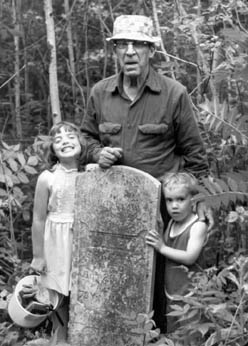
This 1980 photo shows two of my children standing by the gravestone of Saley
Braford, their gt-gt-gt-gt-grandmother, who died in 1864.
Accompanying us as we ventured to find this abandoned cemetery is my father.
Below is a photo of the pelon rubbing I took, of the top part of her stone,
showing a dove and small weeping willow tree.
(yes it's the same stone, with dove barely visible in photo). 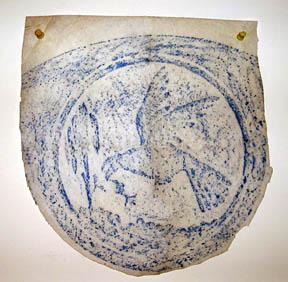
|
When attempting to collect and record information on cemetery tombstones,
whether it is one stone or the entire cemetery, there are a few handy hints
to follow, to make that trip to the cemetery productive.
First, educate yourself regarding the cemetery you will be visiting:
Are
rubbings allowed?
Are certain rubbing materials forbidden?
Get
permission to do rubbings
Preparations
Supplies
water bucket
Large sidewalk chalk, many colors
pelon fabric
masking tape only (no scotch or duct tape!!)
paper and pencil
gum
eraser
wooden popsicle sticks
camera
large pieces of cardboard,
covered with aluminum foil.
large paintbrush, stiff toothbrush (NO WIRE
BRUSH OR SCRUB BRUSH PLEASE)
non-ionic cleaners (no
household soap or bleach)
How to Preserve Tombstone Information
Rubbings
Assess the condition of the stone to be copied. Older
stones are often made of soft limestone, easily crumbled or distorted with
mild pressure. Look for cracks, flaking or any sign that pressure might
damage the stone. If any flaking or possible damage will result, do NOT
continue with the rubbing. Preserve the tombstone record with a photo only.
Cleaning the stone
If tombstone is in good condition for a rubbing, clean the stone. Brush with
dry paintbrush to remove any debris.
Use toothbrush to gently remove any
debris in the carving. Pre-soak tombstone with water, to loosen stubborn
dirt. A gentle soaking is sometimes all that is needed to clean stone. After
presoaking, lichen can often be removed with a gum eraser or wooden popsicle
sticks. If additional cleaners are needed, pre-soaking will prevent the
cleaners from soaking into the stone.
If additional cleaning is needed,
use only non-ionic cleaners on the stone. Gently rub cleaner on the stone,
starting at the base. Rinse frequently.
Do not use excessive force when
rubbing on the stone.
Rubbings
wrap pelon fabric across the part of the tombstone you
wish to copy.
secure the pelon in place with masking tape, so fabric is
held tight to the stone.
Gently rub in one direction, with colored chalk
across the pelon on the tombstone. This will show the tombstone as the chalk
color and any carvings will show white. [See image]
Using pelon has two
advantages - you don't leave any chalk on the stone, and you have an image
of the stone on pelon to take home.
Copying the Data from the Tombstone
Write down the name of the cemetery, and the date of the visit.
In large
cemeteries, indicate what section stone is in, and how to locate the stone.
Write a brief description of the stone, it's shape, images and color.
Copy exactly, the inscription on the face of the stone. Do not correct any
spelling errors, just copy as found on the stone. [put your comments on the
side, in brackets].
Indicate the direction that the face of the stone is
facing (north, south, east, west) Walk around the stone, and copy any data
or images found on the sides and back of the stone.
Copy any saying (Rest
in Peace etc) that is found on the stone.
Look on the base or foundation
of the stone, for any carvers initials.
Look for any footstones on that
plot.
Make note of the names on adjacent stones. (Not only will it help
you to locate the stone in later years, but the adjacent stones could also
be unknown relatives)
How to Photograph Tombstones.
Outdoor photos
will be more colorful, if taken on a cloudy day. (less glare)
Try to have
the sun at your back, but at a slight angle, (5 or 7 o'clock) so that there
is a shadow in the lettering on the stone.
Prop up aluminum-covered
cardboard to reflect light toward tombstone.
A word to the wise
Leaving the cemetery in the same condition that you found it, goes a long
way towards paving a path for the historians of the future. It only takes
one rotton person, to leave a bad impression on a cemetery and its
groundskeepers. Pick up any litter or trash. Do not leave any sign of your
visit. Do not give any caretaker the grounds to bar future rubbings or
unsupervised cemetery visits. We all know of courthouses, that have barred
genealogists after damage was found to public records, so be wise and treat
the stones with care. They may be stone, hard as can be, but they still can
be damaged.
|
| This site represents an ongoing effort to document, and collect visual artifacts related to, the history of Fond du Lac County, Wisconsin.
All works copyright © 1997 -
Disclaimer | Privacy Statement
These electronic pages may not be reproduced in this format for profit or presentation
by any other organization or persons without the permission of WIGenWeb
Project.
** Ruth Shaw Worthing, The History of Fond du Lac County, as told by its Place-Names, 1976.
** The History of Fond du Lac County, Wisconsin, Chicago: Western Historical Company, 1880.
** Portrait and Biographical Album of Fond du Lac County, Wisconsin, Chicago: Acme Publishing Company, 1889.
** A. T. Glaze, Incidents and Anecdotes of Early Days and History of Business in the City and County of Fond du Lac from Early Times to the Present, Fond du Lac: P. B. Haber Printing Company, 1905.
** Maurice McKenna, ed., History of Fond du Lac County, Chicago: S. J. Clarke Publishing Company, 1912.
** Wisconsin Volunteers: War of the Rebellion 1861-1865
** Plat Book of Fond du Lac County, Wisconsin, C. M. Foote & Co. 1893 |